


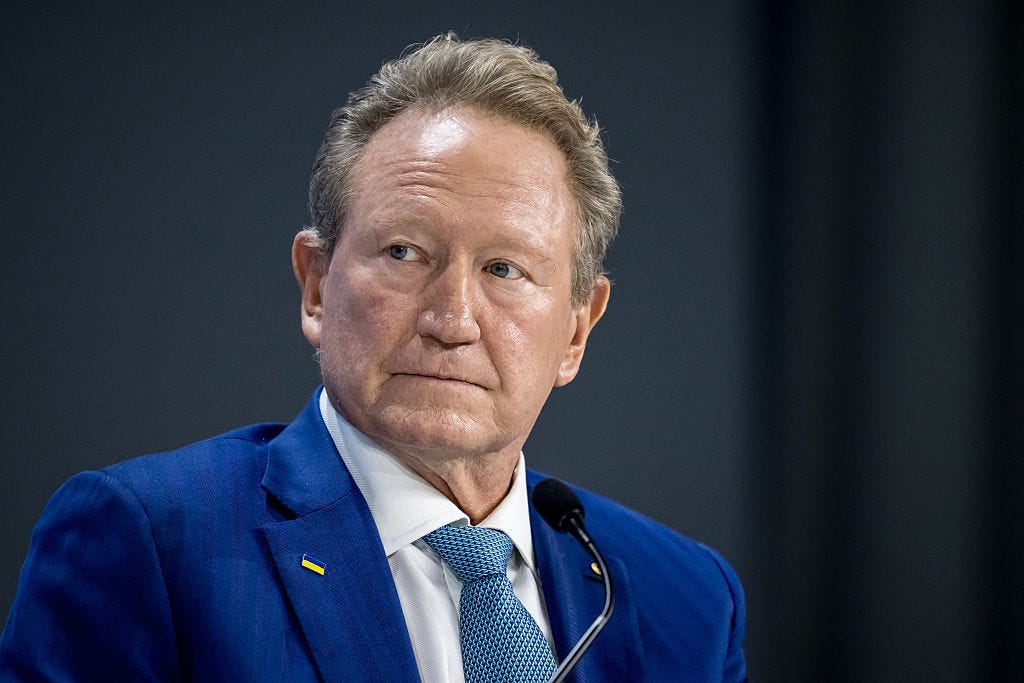
Five years ago, Andrew “Twiggy” Forrest, the billionaire founder of the Australian iron ore miner Fortescue, came to believe that hydrogen made from renewables was the future of energy. “The solution is hydrogen,” declared Forrest. He predicted the market for “green hydrogen,” made from using electricity to break apart water (H20) into hydrogen gas (H2) and oxygen, would grow to “at the very least” US$12 trillion by 2050, which would be “bigger than any industry we have.” He promised that Fortescue, his company that had just earned US$10.3 billion in a year selling ore to Chinese steel mills, would make 15 million tonnes of green hydrogen a year by 2030, which is more than the total currently produced globally. “Can a Carbon-Emitting Iron Ore Tycoon Save the Planet?” asked the New York Times, and quoted the climate scientist Michael Mann saying, “Such efforts are critical to addressing climate change in the window we have.”
Forrest was not alone. Frans Timmermans, the European Commission’s climate chief, called hydrogen “a growth engine” in 2020 and set a target of 40 gigawatts of electrolysers, the machines that split water into hydrogen and oxygen, by 2030. Australia’s chief scientist Alan Finkel said in 2018 that “hydrogen’s time has come.” By August 2023, governments had announced US$280 billion in hydrogen subsidies.
Americans have a particular reason to care. The Biden administration committed $7 billion in federal funding from a 2021 infrastructure law to establish seven regional clean hydrogen hubs across the United States with the goal of catalyzing an additional $40 billion in private sector funding. The Trump administration has since cut most of that money.
The reason for the cuts is that hydrogen projects have failed around the world as it became clear they had not reduced the price of hydrogen. For example, Air Products, an American industrial gas company, exited a Louisiana hydrogen project last June at a cost of US$2.9 billion.
And now, Forrest’s mining empire is struggling, in part due to its focus on hydrogen rather than diversifying its core business, as its competitors did. Fortescue’s shares have fallen about 36% from their May peak. It reported last week that its cash fell from US$5.1 billion on June 30 to US$3.2 billion on September 30. Its debt tripled from US$0.9 billion to US$2.8 billion in the same quarter. The company shipped 47 million tonnes of ore but sold only 43 million.
The reason is that the China Mineral Resources Group, a state buyer that Beijing created in 2022 to purchase iron ore for China’s steel mills, is demanding lower prices that Forrest and Fortescue won’t accept. And so CMRG in July ordered Chinese steel mills to stop taking delivery of Fortescue products. Now, Fortescue’s output is piling up in Chinese ports.
Fortescue may be forced to significantly cut back production in Australia, which could result in job losses. “If negotiations with CMRG are not concluded by the calendar year-end, operations may be affected, potentially including adjustments to production,” the company warned in its quarterly report.
Part of the problem was that Forrest bet big on a hydrogen business while his competitors, Rio Tinto and BHP, had instead diversified away from ore into copper. Those two companies then accepted lower prices for their ore from China. Had Forrest followed their lead, he would not be in so much financial trouble today.
His enthusiasm for hydrogen was not matched by reality. And so, in 2024, Fortescue offered early retirements to 700 people and shelved the 15 million tonne target. In July 2025, it cancelled its Arizona hydrogen plant and its electrolyser project at Gladstone in Queensland, writing down about US$150 million.